

Jan 14, 2026
In collaboration with a team of researchers based at the Woods Hole Oceanographic Institution and San Diego State University, the Northeast Ocean Data Portal has added several new data products that show how habitat use of highly migratory species has changed over time and how it may continue to change in the next several decades.
The Fisheries and Climate Toolkit (FaCeT) is an ongoing project with funding from NASA’s Ecological Conservation program and NROC. This work addresses a data gap for highly migratory species and pelagic ecosystems that had been identified and often discussed by researchers and other experts working with NROC and RWSC. The FaCeT team is focused on co-developing a wide range of data products and their visualizations designed specifically with and for ocean managers based on an understanding of changing ocean conditions. The FaCeT team recently presented their work to the RWSC Habitat & Ecosystem Subcommittee (see December 11 2025 meeting materials).
Some of the new data products depict past and future potential habitat suitability for six commercially-important highly migratory fishery species: Bigeye tuna, Bluefin tuna, Blue shark, Yellowfin tuna, Shortfin mako, and Swordfish. These products can be found within the Fish topic in the Data Explorer under two new subtopics (described below).
Other new data products show the timing and extent of marine heatwaves. These products can be found within the Ocean Conditions & Water Quality topic (described below).
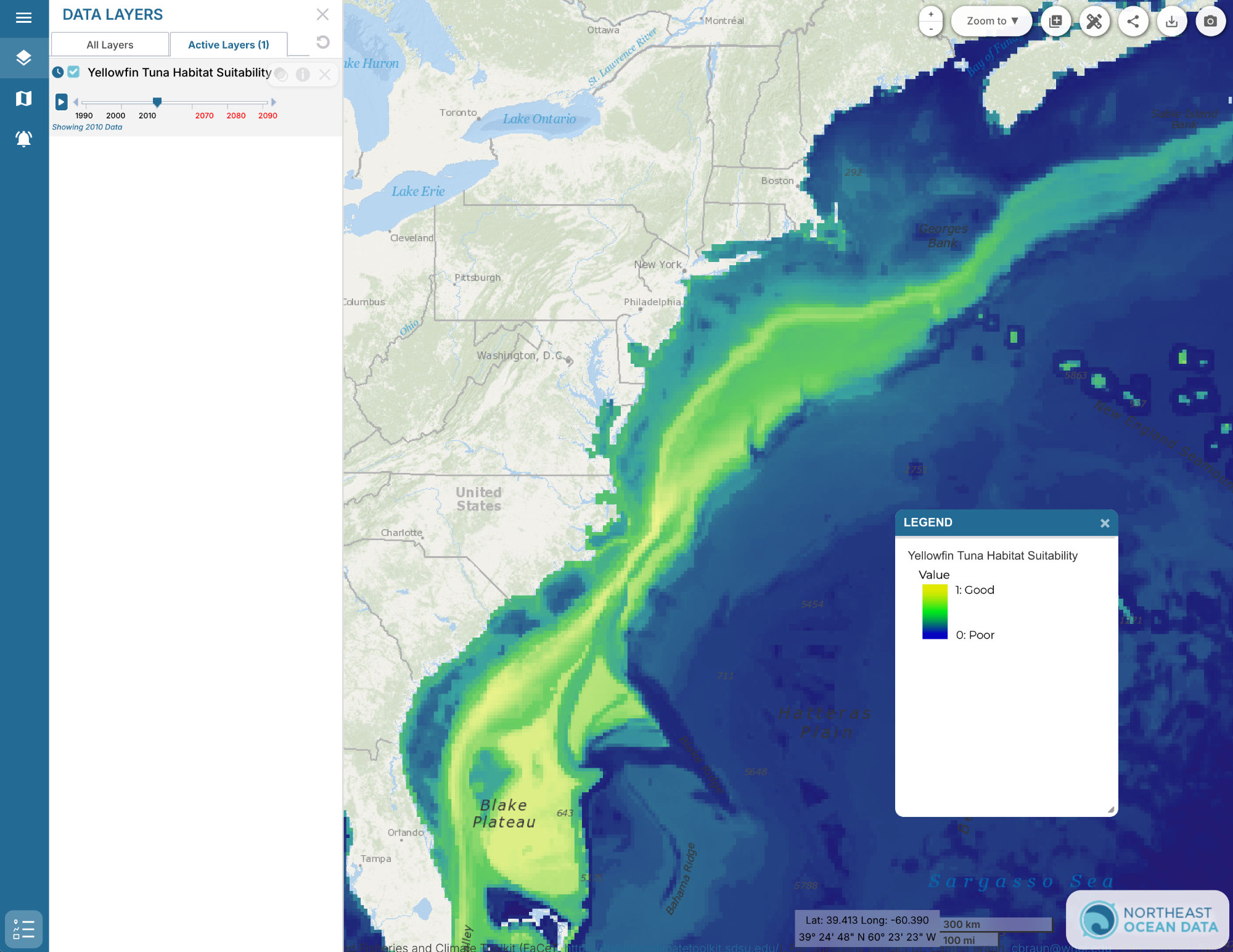
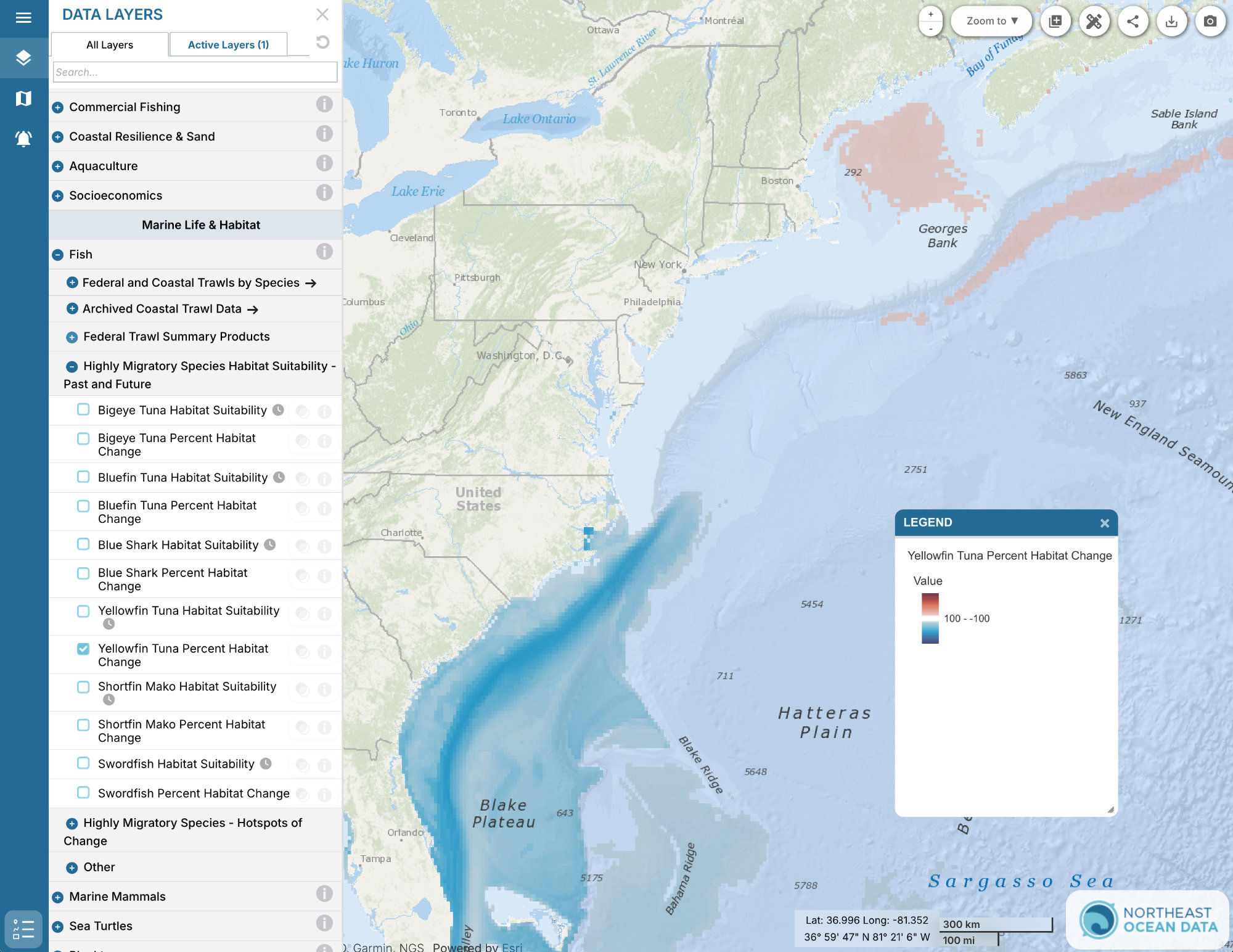
Fish > Highly Migratory Species Habitat Suitability – Past and Future: These layers show predicted habitat suitability for each species on decadal timescales to provide estimates of expected change to species’ habitats in the contemporary (1990s to 2010s) and future (2070s to 2090s) ocean. Users can explore habitat suitability for each species over each decade using a time slider. Other layers within this subtopic show the change in habitat suitability for each species between the contemporary and future periods using a percent change metric.

Data Provider(s):
- Woods Hole Oceanographic Institution
- San Diego State University
- Fisheries and Climate Toolkit (FaCeT)
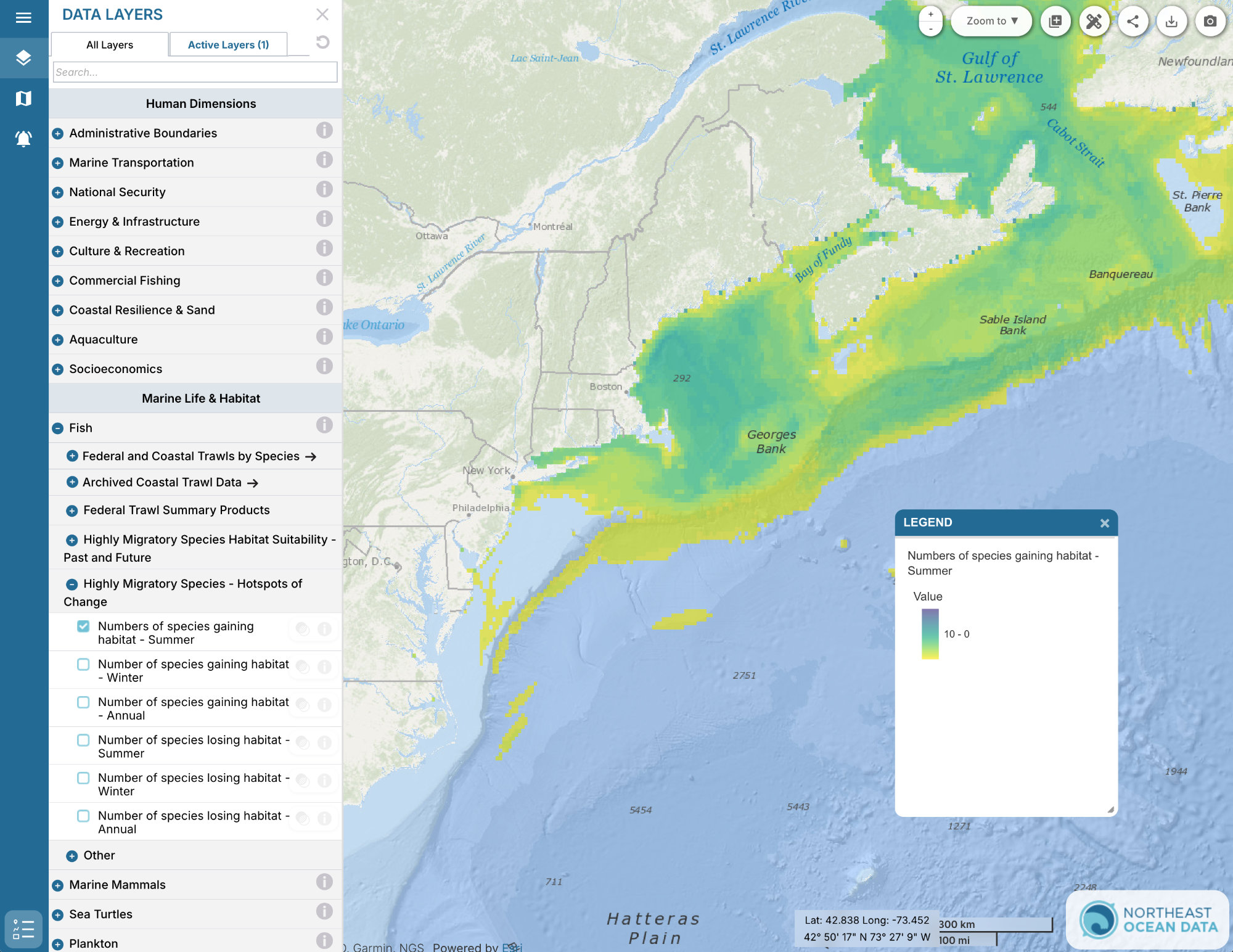
Fish > Highly Migratory Species Habitat Suitability – Hotspots of Change: these layers build on the habitat suitability products above to show the predicted gain or loss of habitat suitability for 12 highly migratory species under future ocean conditions during summer (monthly average of June, July, August), winter (monthly average of December, January, February), and annually (12-month average). There are six additional species’ habitat suitability used to derive these products that will be soon added to the Portal: Albacore tuna, Skipjack tuna, Porbeagle shark, White marlin, Blue marlin, and Sailfish.
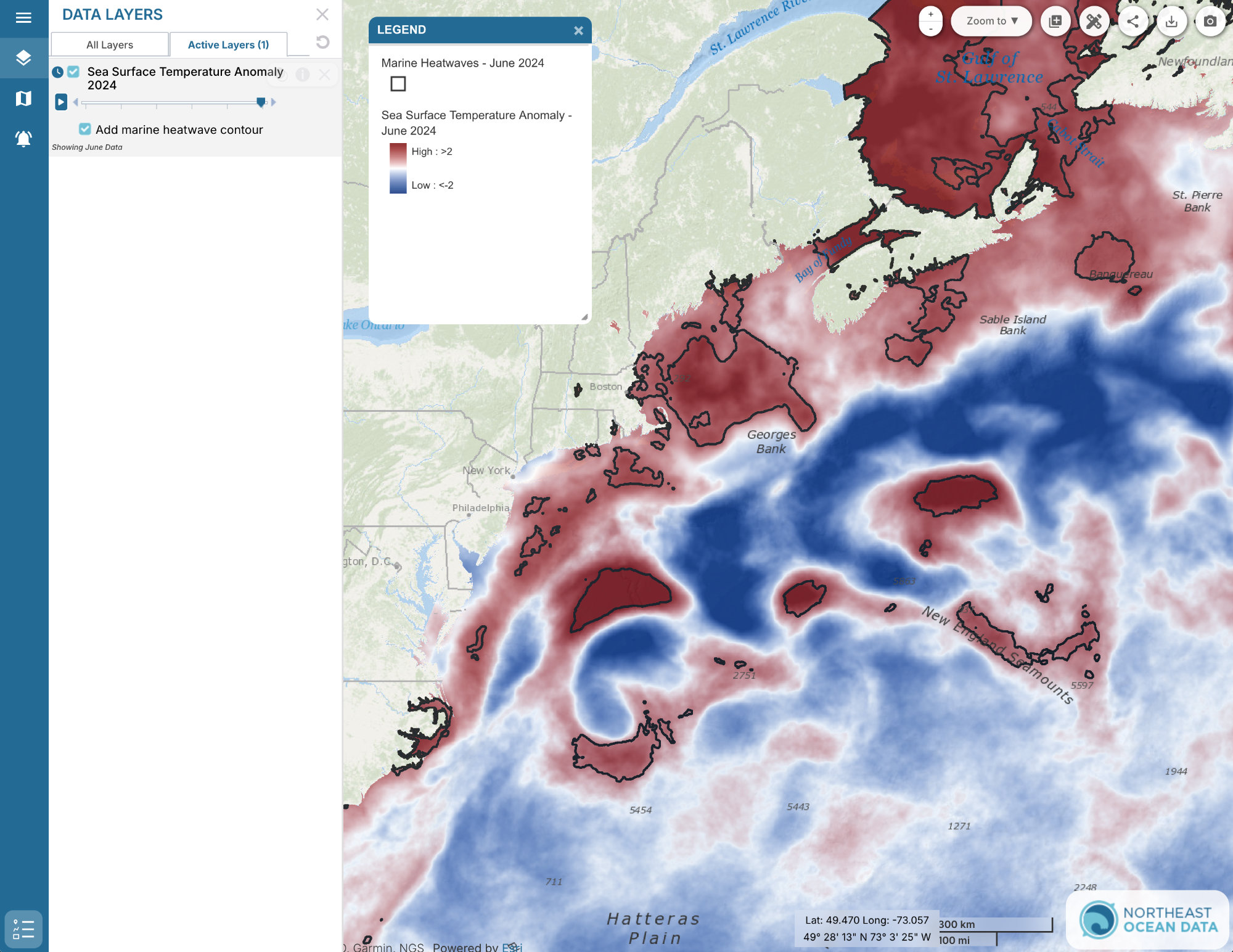
Ocean Conditions & Water Quality > Marine Heatwaves: Marine Heatwaves (MHWs) are short-term extreme warming events, typically reported as deviations or anomalies from average temperatures. Anomalous water temperatures from MHWs are leading to a wide range of impacts such as mass mortalities and strandings of marine species, shifts in species distributions, and alterations to ecosystem structure and function. MHW events vary in intensity, spatial extent, and duration as they are driven by a range of complex oceanographic and atmospheric processes. These maps depict monthly MHWs for several example years that highlight the variability in heatwave conditions in the Northwest Atlantic Ocean. Users can view monthly data for each year via the timeslider on the Active Layers tab. The maps show a sea surface temperature anomaly contour that outlines the spatial area under marine heatwave conditions for each month. The MHW contour outlines pixels experiencing a monthly sea surface temperature anomaly above the 90th percentile of the seasonal threshold for that pixel (2000-2020 climatological baseline).
More information:
- Fisheries and Climate Toolkit
- Nima Farchadi et al., 2024. Marine heatwaves redistribute pelagic fishing fleets. Fish and Fisheries 25, 602–618. https://doi.org/10.1111/faf.12828
- Camrin D. Braun et al., 2023. Widespread habitat loss and redistribution of marine top predators in a changing ocean. Science Advances 9, eadi2718. https://doi.org/10.1126/sciadv.adi2718
- Nima Farchadi and Laura H. McDonnell et al., 2025. Marine heatwaves are in the eye of the beholder. Nature Climate Change 15, 236-239. https://doi.org/10.1038/s41558-025-02257-6